[1]:
%pylab inline
from IPython.display import Image
Populating the interactive namespace from numpy and matplotlib
Quick introduction of the idea
Convolutional-type Constraint
Our goal is to construct a density field realization \(f(\mathbf x)\) subject to a set of \(M\) constraints:
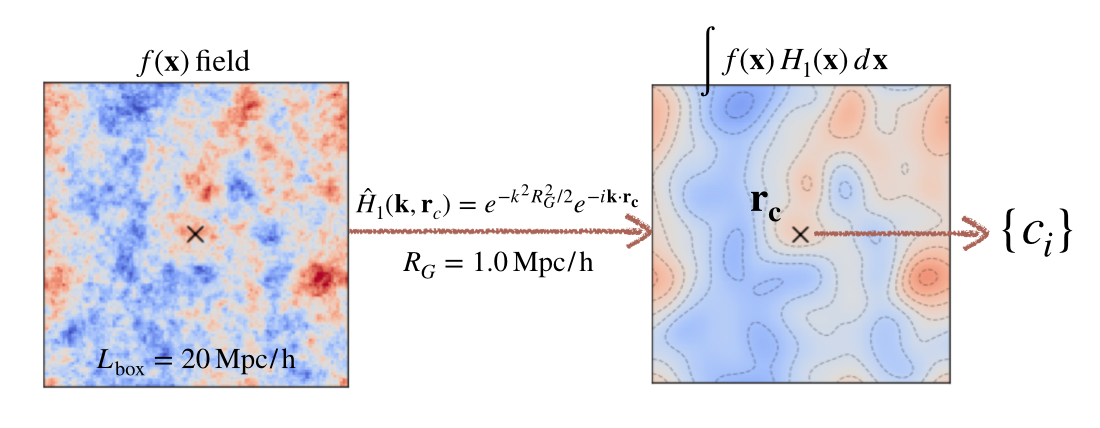
The constraint \(C_i[f;\mathbf r_c]\) can be viewed as a functional of the \(f(\mathbf x)\) field to have specific value \(c_i\) at position \(\mathbf x = \mathbf r_c\). We only consider linear functionals of the field, that the constraint value \(c_i\) is obtained by convolving the \(f(\mathbf x)\) field with some kernel \(H_i(\mathbf x, \mathbf r_c)\) leading to the convolved field value at position \(\mathbf r_c\). We can write \(C_i\) in the form of:
As an simple example below, we convolve the linear density field (2D projection) with a simple Gaussian kernel of width 1 Mpc/h and aim to constrain/specify the convolved value at center \(\mathbf r_c\) to be \(c_i\)
[2]:
Image(filename='convolve.png', width=600)
[2]:
Ensemble Mean Field \(\bar{f}_{\Gamma}(\mathbf x)\)
Given a certain constraint set \(\Gamma\), one can build a corresponding “ensemble mean field” via:
where \(\xi_i(\mathbf x) = <f(\mathbf x)C_i[f;\mathbf r_c]>\) is the average of the cross-correlation between the \(f(\mathbf x)\) field and the \(i\)th constraint \(C_i\), and \(\xi^{-1}_{ij}\) is the (\(ij\)) th element of the inverse of constraint’s covariance matrix \(<C_i C_j>\).
Using the definition of the matter power spectrum \(P(k)\),
we can write down the formalism for \(\xi_i(\mathbf x)\) and \(\xi_{ij}\) as follows:
and
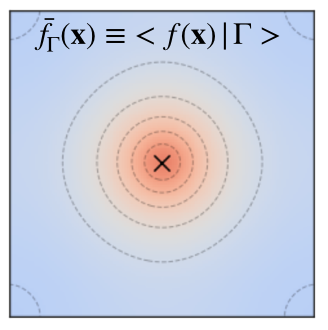
Intuitively, the ensemble mean field \(\bar{f_{\Gamma}}(\mathbf x)\) can be interpreted as the “most likely” field subject to the set of constraints \(\Gamma\).
For example, the field shown below is the ensemble mean field corresponding to a 3\(\sigma_0\) peak at the center of the box:
[3]:
Image(filename='ensemble-mean.png', width=180)
[3]:
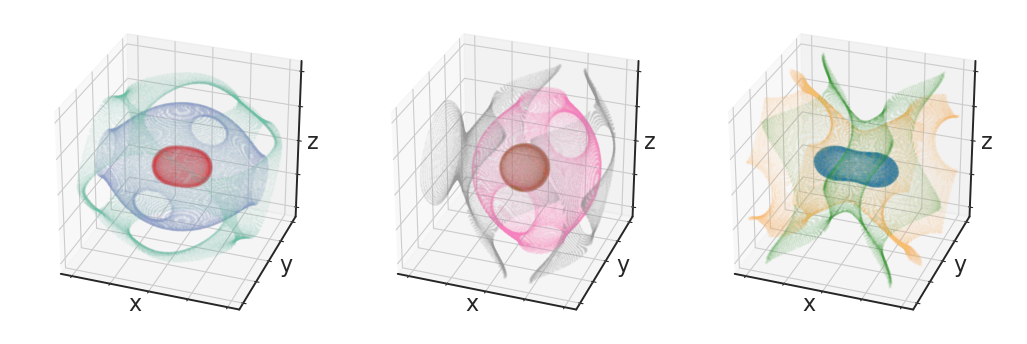
With a combination of different types of constraints \(C_i\) (with kernel \(H_i(\mathbf k)\)), we can construct ensemble mean field that specifies the shape (left plot), peculiar velocity (middle) and tidal field (right) at the site of the peak. See Build_Ensemble_Mean_Field in the tutorial for further details.
[4]:
Image(filename='contour3D-ensemble.png', width=600)
# a 3D illustration of the ensemble mean field constructed via different constraints
[4]:
Construct a constrained realization
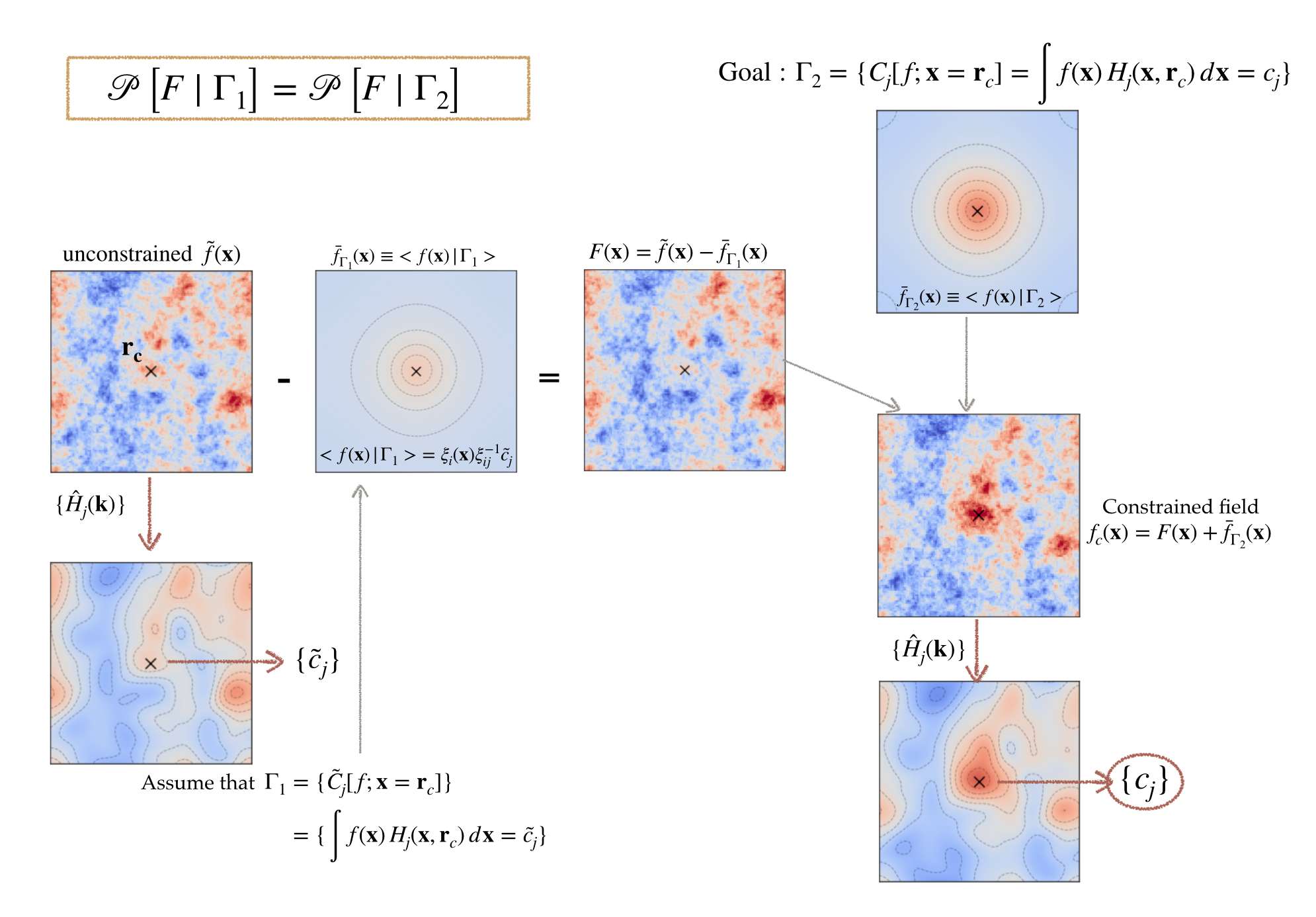
The CR formalism further introduces the “residual field” \(F(\mathbf x) \equiv f(\mathbf x) - \bar{f_{\Gamma}}(\mathbf x)\) as the difference between an arbitrary Gaussian realization \(f(\mathbf x)\) satisfying the constraint set \(\Gamma\) and the ensemble mean field \(\bar{f_{\Gamma}}(\mathbf x)\) of all those fields. The crucial idea behind the CR construction method is based on the fact that, the complete probability distribution \(\mathscr{P} [F|\Gamma]\) of the residual field \(F(\mathbf x)\) is independent of the numerical values \(c_i\) of the constraints \(\Gamma\).
i.e., for any \(\Gamma_1\), \(\Gamma_2\), we have
Therefore, one can construct the desired realization under constraint sets \(\Gamma\) by properly sampling a residual field \(F(\mathbf x)\) from a random, unconstrained realization \(\tilde{f} (\mathbf x)\) and then adding that \(F(\mathbf x)\) to the ensemble field \(\bar{f_{\Gamma}}(\mathbf x)\) corresponding to \(\Gamma\).
The formalism can be written as:
i.e., we are treating the original \(\tilde{f}(\mathbf x)\) as a field subject to constraint sets \(\tilde{\Gamma}\) with value \(\tilde{c}_j = C_j [\tilde{f}; \mathbf r_c]\), (\(\tilde{c}_j\) is the original value of the unconstrained field), and \(\bar{f}_{\tilde{\Gamma}}(\mathbf x) = \xi_i(\mathbf x) \xi^{-1}_{ij} \tilde{c}_j\) is the ensemble mean field corresponding to \(\tilde{\Gamma}\). From \(\tilde{f}(\mathbf x) - \bar{f}_{\tilde{\Gamma}}(\mathbf x)\) we get the residual field \(F(\mathbf x)\) from a random unconstrained realization, and adding that to \(\bar{f}_{\Gamma}(\mathbf x)\) results in the field \(f(\mathbf x)\) satisfying constraint \(\Gamma\).
Below is an illustration of the procedure:
[5]:
Image(filename='apply-constraint.png', width=900)
[5]: